Preschool vs. Pre-K: What Is the Difference?
Preschool and Pre-K are often used interchangeably, but they do not always mean exactly the same thing. For families comparing early-childhood programs in Sugar Land and Missouri City, understanding the difference can make it easier to choose the right environment for your child’s age, readiness and next stage.
The Short Answer
Preschool is a broad term for early-childhood education before kindergarten. Pre-K usually refers to the stage immediately before kindergarten and often places additional emphasis on kindergarten readiness. The exact age ranges and program structure can vary by school.
What Is Preschool?
Preschool generally describes an educational program for young children before kindergarten. Depending on the school, preschool may include children across more than one age level.
The preschool years are a period of rapid development in language, movement, social interaction, independence, concentration and early academic understanding.
A strong preschool program gives children opportunities to develop those skills through meaningful experiences rather than simply trying to reproduce an elementary-school classroom at a younger age.
Families exploring local options can start with MSSL’s Preschool & Pre-K in Sugar Land and Missouri City guide.
What Is Pre-K?
Pre-K, short for prekindergarten, generally refers to education during the period immediately before kindergarten.
In Texas public schools, Pre-K also has a specific meaning under state eligibility and program rules. Private schools and early-childhood programs may use the term more broadly when describing programming for children approaching kindergarten.
Because terminology varies, parents should ask each school exactly what it means by “Pre-K,” which ages the classroom serves and how the program connects to kindergarten.
Preschool vs. Pre-K: The Main Differences
Swipe to compare all columns →
| Question | Preschool | Pre-K |
|---|---|---|
| Main purpose | Broad early-childhood development and learning | Continued development with increasing kindergarten readiness |
| Age | Can include a broader preschool-age range | Usually children approaching kindergarten |
| Academics | Early foundations in language, math and exploration | Continues those foundations at increasing complexity |
| Independence | Developing classroom and self-care routines | Increasing responsibility and readiness for the next school stage |
| Program definition | Varies considerably by school | Also varies, especially between public and private programs |
Is Pre-K More Academic Than Preschool?
Not necessarily.
A quality early-childhood program should not measure readiness only by how many worksheets children complete or how early they memorize academic facts.
Kindergarten readiness also includes the ability to communicate, follow routines, concentrate, care for belongings, solve small problems, interact with other children and complete increasingly complex tasks.
Academic readiness is an important goal at MSSL. In Montessori early childhood, language activities build vocabulary and awareness of letter sounds, while hands-on math connects counting and number symbols with real quantities. Children progress toward more complex work as their understanding grows.
These academic foundations develop alongside concentration, independence and the social skills children use to participate in a classroom.
Where Does Montessori Fit?
Montessori does not divide the early-childhood experience into preschool and Pre-K in exactly the same way many conventional programs do.
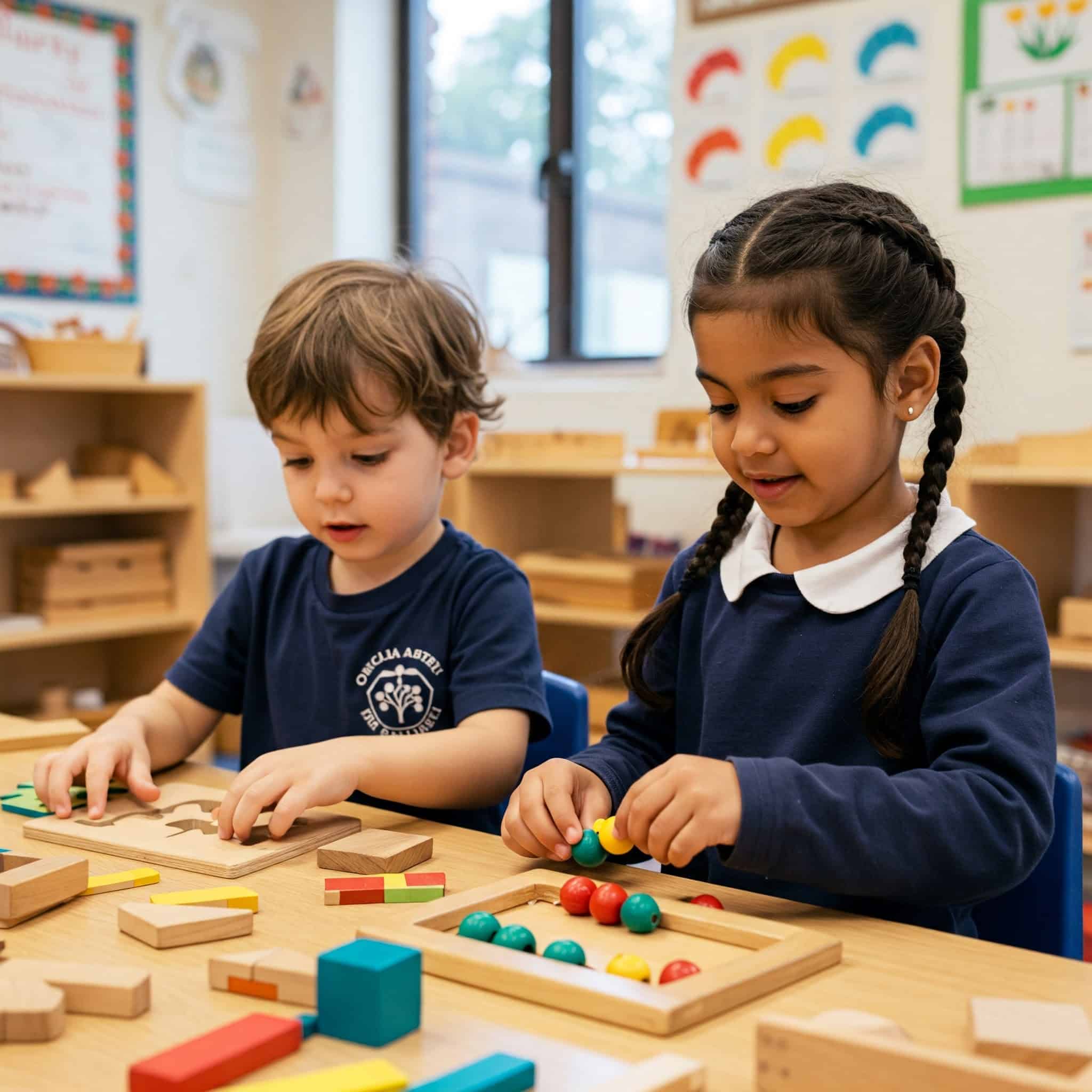
Montessori Early Childhood is commonly organized as a multi-age learning cycle. Children remain within a prepared environment while their work progresses from foundational practical and sensorial experiences toward increasingly sophisticated language, mathematics and cultural studies.
This means a younger preschool child and an older child preparing for kindergarten may share the same broader classroom community while working at very different developmental levels.
At MSSL, preschool and Pre-K are part of our Montessori Primary program for ages 3–6. Our low student-to-teacher ratios support individual attention as children build reading and math foundations. On your tour, ask how teachers choose the next lesson and support children who need more practice or are ready to move ahead.
Families who want to understand the philosophy behind this model can explore MSSL’s Montessori School in Sugar Land and Missouri City guide.
How Montessori Primary Connects Preschool, Pre-K and Kindergarten
One reason Montessori terminology can initially confuse parents is that the Primary classroom can span what families commonly think of as preschool, Pre-K and kindergarten.
Instead of treating each year as a separate curriculum that starts over every fall, children can continue working within a familiar environment while lessons become progressively more advanced.
A Younger Child May Be Building Foundations
Earlier in the cycle, children may spend substantial time on Practical Life, Sensorial activities, vocabulary, sound awareness, counting and classroom routines.
An Older Child May Work at Greater Complexity
As readiness develops, the same environment can support increasingly sophisticated work in reading, writing, mathematics, science, geography and cultural studies.
Kindergarten Can Be the Culminating Stage
For children who continue through the full Montessori Primary cycle, kindergarten can become a year of greater responsibility, leadership and consolidation rather than an entirely separate educational experience.
Families considering that stage can explore MSSL’s Private Kindergarten in Sugar Land and Missouri City guide.
Which Is Better: Preschool or Pre-K?
The answer depends on what you mean by the terms.
A school may call a classroom preschool while another school calls a similar age group Pre-K. The label itself does not determine the quality of the environment.
Parents should focus on:
- the actual ages served
- teacher experience, preparation and the amount of individual attention children receive
- the daily schedule
- how children spend most of their day
- classroom materials
- opportunities for independence
- language and early literacy experiences
- mathematics and problem solving
- social development
- how the program prepares children for their next stage
Is My Child Ready for Preschool?
Preschool readiness is not a checklist of academic skills.
A child entering preschool may still be learning how to separate comfortably from caregivers, communicate needs, follow a classroom routine and participate around other children.
At MSSL, classroom placement is based on developmental readiness. Some children benefit from more time in Transition, around ages 2.5–3.5, to build toileting independence, daily routines and classroom skills before moving into Primary. The age ranges overlap so families and teachers can plan the move around the child’s needs.
Is My Child Ready for Pre-K?
A child approaching the year before kindergarten may be ready for increasingly complex classroom responsibilities and learning.
Useful indicators can include growing ability to:
- communicate clearly with adults and peers
- participate in classroom routines
- work independently for increasing periods
- care for personal belongings
- listen and respond to directions
- manage frustration with appropriate support
- show curiosity about language, numbers and the world
Development is not identical from child to child, so these should be viewed as areas of growth rather than rigid entrance tests.
Questions to Ask When Comparing Preschool and Pre-K
A school tour is the best time to move beyond terminology. Consider asking:
- What ages are in this classroom?
- How do you define preschool and Pre-K?
- Does my child change classrooms between preschool and Pre-K?
- What does a typical day look like?
- How much uninterrupted activity time do children have?
- How do teachers know when a child is ready for new work?
- How are language and mathematics introduced?
- How does the program support independence?
- How is kindergarten readiness approached?
- How do you communicate progress with families?
Choosing Preschool or Pre-K in Sugar Land and Missouri City
Local families should also consider practical factors such as commute, school hours, campus location, program availability and whether the school can continue serving the child as developmental needs change.
Sugar Land Campus
4502 Austin Parkway
Sugar Land, TX 77479
Sienna Campus in Missouri City
8900 Sienna Ranch Road
Missouri City, TX 77459
Preschool, Pre-K or Montessori: Focus on the Actual Experience
Preschool and Pre-K can be useful labels, but they should not be the only basis for choosing a school.
Look at what your child will experience each day: the classroom, teachers, materials, routines, expectations and opportunities to become increasingly capable.
For families interested in Montessori, the multi-age Primary cycle can provide continuity across the preschool, Pre-K and kindergarten years while allowing the level of work to change substantially as the child develops.
Continue Exploring MSSL
1. Preschool & Pre-K — start here
Preschool & Pre-K in Sugar Land & Missouri City →
2. Montessori School
Montessori School in Sugar Land & Missouri City →
3. Private Kindergarten
Private Kindergarten in Sugar Land & Missouri City →
See the Difference in Person
Visit MSSL Sugar Land or Sienna to see the classroom environment and talk with the team about your child’s age, current stage and program options.