
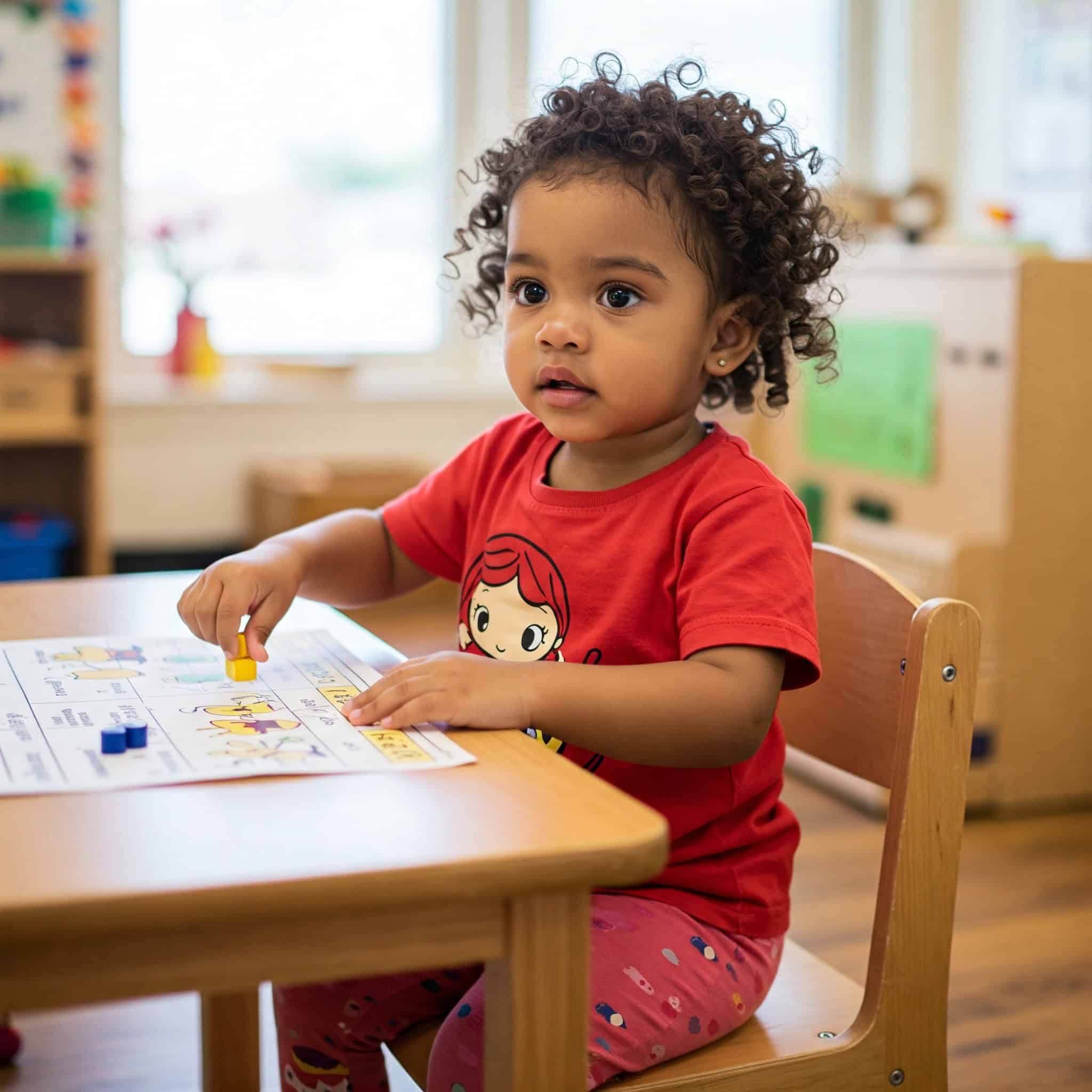
Is My 2-Year-Old Ready for a Toddler Program? 12 Signs Parents Should Know
If you are wondering whether your 2-year-old is ready for a toddler program, look for growing curiosity, emerging communication, interest in other children, comfort with simple routines and a strong desire to do things independently.
Your child does not need to be fully verbal, completely comfortable separating from you or fully toilet trained to benefit from a thoughtfully prepared toddler environment. Readiness is not a test that a two-year-old must pass. It is a collection of developing abilities that the right classroom can continue to support.
For families in Sugar Land, Missouri City and nearby Fort Bend communities, choosing a toddler program also raises practical questions about separation, routines, care, learning and safety. This guide explains what readiness can look like and what parents should observe when comparing programs.
What Does “Ready for a Toddler Program” Really Mean?
Development at age two is rarely even. One child may use long sentences but find separation difficult. Another may confidently enter a classroom while communicating mostly through gestures and a few words.
Both children may be ready for a well-designed toddler program.
The better question is not whether your child has mastered every skill. It is whether the classroom can safely support the skills your child is beginning to develop.
A strong toddler environment should provide:
- predictable routines
- patient and responsive adults
- child-sized materials and furniture
- freedom to move safely
- hands-on activities
- language-rich interaction
- outdoor time
- appropriate rest and care routines
- opportunities to repeat activities
- gradually increasing independence
A child may show only some readiness signs, show them inconsistently or display them at home but not immediately in a new environment. That can be completely normal.
12 Signs Your 2-Year-Old May Be Ready for a Toddler Program
1. Your Child Is Curious About the World
Two-year-olds are natural investigators. They open, close, carry, stack, pour, sort and examine almost everything around them.
If your child watches adults closely, experiments with objects or returns repeatedly to a favorite activity, a prepared toddler classroom can give that curiosity a purposeful direction.
In Montessori, curiosity is not treated as a distraction. Children are given carefully selected activities that allow them to explore how things work within clear, safe limits.
2. Your Child Wants to Do Things Independently
“Me do it” captures an important part of toddler development.
Your child may try to put on shoes, wipe a spill, carry a plate, wash hands or use a spoon independently. The attempt may be slow or messy, but the desire to participate matters.
A quality toddler program gives children time to try rather than immediately completing every task for them.
Child-sized tools and carefully demonstrated routines can turn everyday moments into opportunities for confidence, coordination and independence.
3. Your Child Shows Interest in Other Children
A two-year-old does not need to share perfectly or participate in long periods of cooperative play.
Parallel play—playing beside another child—is normal at this stage.
Readiness may look like:
- watching other children
- copying another child’s actions
- moving closer to a group
- mentioning another child
- showing curiosity about what peers are doing
A consistent classroom community gives toddlers opportunities to observe, practice simple social language and gradually learn how to participate around others.
4. Your Child Can Communicate Basic Needs
Communication does not have to mean complete sentences.
A toddler may use words, sounds, gestures, signs, facial expressions or body language to communicate ideas such as:
- more
- help
- water
- all done
- hurt
- tired
Experienced toddler teachers pay attention to both verbal and nonverbal communication while continuously modeling clear language.
5. Your Child Can Sometimes Follow a Simple Direction
If your child occasionally responds to a request such as “bring your shoes,” “put the cup on the table” or “come wash your hands,” that is a useful beginning.
Toddlers are not expected to respond perfectly every time. Hunger, fatigue, excitement and attention all affect their ability to follow directions.
Predictable classroom routines help because children begin to understand what happens next through repetition.
6. Your Child Is Beginning to Tolerate Short Separations
Your toddler may already stay comfortably with a grandparent, relative or familiar caregiver for short periods.
That can indicate a growing understanding that a parent can leave and return.
Children who have had very few separations can still begin school successfully. Tears at drop-off do not automatically mean your child is not ready.
A calm handoff, predictable goodbye and consistent reunion can gradually help a child develop trust in the new routine.
7. Your Child Responds Well to Predictable Routines
Many toddlers feel safer when daily life follows a recognizable rhythm.
Your child may already anticipate familiar events such as breakfast, getting dressed, going outside, lunch, rest or bedtime.
A good toddler classroom is orderly without being rigid. Arrival, activity time, meals, toileting, outdoor play and rest follow a dependable pattern that helps children know what to expect.
8. Your Child Enjoys Hands-On Activities
Notice which activities hold your child’s attention.
Many toddlers are naturally drawn to:
- scooping
- pouring
- transferring
- fitting objects together
- matching
- scrubbing
- drawing
- kneading
- carrying
- helping with household routines
These activities strengthen coordination and concentration while allowing children to learn through direct experience.
9. Your Child Is Developing Physical Coordination
Walking with increasing confidence, carrying objects, climbing with supervision, turning pages and attempting to pour are all examples of developing control.
Children do not need perfect balance or fine-motor precision before entering a toddler program.
They need safe opportunities to continue practicing movement.
10. Your Child Explores but Returns to You for Reassurance
A toddler may approach an unfamiliar activity, explore for a moment and then look back at a parent before continuing.
This combination of attachment and exploration is developmentally appropriate.
A cautious temperament does not mean a child is not ready. The right classroom gives children time to observe and gradually develop trust in another caring adult.
11. Your Child Is Beginning to Participate in Self-Care
Your two-year-old may:
- push an arm through a sleeve
- help pull clothing up or down
- throw away a tissue
- wash hands with help
- carry a cup
- show awareness of a wet diaper
- participate during diapering or toilet learning
These are early steps toward independence.
Full toileting independence should not automatically be treated as the standard for toddler readiness. Parents should ask each school about its specific toileting policies and expectations.
12. Your Family Is Ready for a Consistent Partnership
Toddler readiness also involves the family.
Consider whether you can:
- maintain a reasonably consistent arrival routine
- communicate openly with teachers
- support a predictable goodbye
- allow the adjustment process time to unfold
- share useful information about sleep, language, routines and temperament
You do not need to feel completely certain. Starting a first school experience can be emotional for parents as well as children.
How Montessori Supports Two-Year-Old Development
Montessori education begins with respect for the child as a capable person.
For toddlers, that principle is visible in the physical environment, the way adults interact with children and the pace of the day.
Shelves are low. Furniture fits small bodies. Materials are organized so children can see, select, use and return them with increasing independence.
Practical Life
Practical Life activities connect classroom learning with meaningful everyday experiences.
Examples may include:
- pouring
- spooning
- sweeping
- washing
- dressing activities
- simple food preparation
- care of the environment
These experiences can support coordination, concentration, sequencing, order and independence.
Language
Toddlers are developing language rapidly.
Teachers support this development through conversation, songs, stories, poems, real objects, pictures and precise vocabulary connected to daily experiences.
Language also becomes increasingly useful socially as children learn ways to request help, express needs and interact with others.
Sensorial Exploration
Young children organize their understanding through the senses.
Purposeful experiences can invite toddlers to notice differences in:
- color
- texture
- dimension
- shape
- sound
- temperature
- weight
Outdoor Learning and Movement
Outdoor time is an important part of toddler development.
Walking, balancing, digging, carrying, observing plants and insects, and experiencing different surfaces give children opportunities to strengthen movement while developing language and curiosity about the natural world.
Families interested in this age group can explore the MSSL Toddler Program first.
What Can a Day in a Montessori Toddler Program Look Like?
A typical day begins with a personal welcome and a clear place for belongings.
After saying goodbye, children enter an orderly environment with familiar materials available.
One child may be transferring objects while another looks at books. Another may watch the classroom for several minutes before deciding what to do.
During a work period, children may:
- choose appropriate materials
- receive individual or small-group presentations
- repeat favorite activities
- practice Practical Life routines
- participate in language activities
- return materials when finished
Meals, care routines, outdoor play, rest and occasional group experiences fit into the day’s broader rhythm.
Common Parent Concerns About Starting at Age Two
“My Child Cries at Drop-Off”
Separation anxiety can be very normal at this age.
Crying communicates a real feeling, but it does not automatically mean that school is harmful or that your child is not ready.
A brief and predictable goodbye can make the transition clearer.
Ask teachers:
- how long your child typically remains upset
- what provides comfort
- whether your child later begins playing or working
- whether your child connects with a particular teacher
“My Child Is Not Potty Trained”
Many two-year-olds are still in diapers or only beginning toilet learning.
Ask the program about its written policy, supplies, communication procedures and approach to accidents.
Home and school can support the same process without placing unnecessary pressure on the child.
“My Child Does Not Talk Much Yet”
Children enter toddler classrooms at many different stages of expressive language.
Teachers should recognize gestures, sounds and other forms of communication while continually modeling words and conversation.
Share the words, signs or languages your family uses at home so teachers can better understand your child.
“My Child Still Naps”
Rest remains important at age two.
Ask when and where children rest, how the classroom handles different sleep needs and whether comfort items are permitted.
“My Child Does Not Share”
Perfect sharing is not a toddler entrance requirement.
Children are still developing impulse control and understanding of ownership and turn-taking.
A strong classroom provides enough meaningful activity, models respectful interaction and helps children develop language for navigating conflicts.
How to Choose a Toddler Program in Sugar Land or Missouri City
Location matters, but classroom quality matters just as much.
Families comparing toddler care in Sugar Land, Missouri City, Sienna and nearby Fort Bend communities should visit programs in person whenever possible.
A tour lets you observe things a website cannot fully show:
- the emotional tone of the classroom
- how adults speak to children
- whether materials are organized
- whether children appear meaningfully engaged
- how much independence children are given
- how transitions are handled
Families comparing broader childcare options can also review MSSL’s Daycare & Childcare in Sugar Land and Missouri City guide.
Questions to Ask During a Toddler Program Tour
- How do teachers help a new child through separation?
- What training and toddler experience do classroom teachers have?
- How are diapering and toilet learning handled?
- How are meals and rest handled?
- How much uninterrupted activity time do children have?
- How much outdoor time is included?
- How do teachers respond to biting, hitting or conflicts over materials?
- How does the school communicate with families?
- How are allergies, illness and medications handled?
- How does the classroom reflect Montessori principles?
Look beyond a long list of activities.
Toddlers often benefit most from stable relationships, repetition, thoughtful routines, a well-prepared environment and adults who allow time for children to participate independently.
How to Prepare Your Two-Year-Old for a Toddler Program
- Talk simply and positively. Explain that your child will spend time with teachers and other children and that you will return.
- Practice short separations. When possible, allow your child to spend brief periods with a trusted adult.
- Build predictable mornings. Preparing clothing and needed items in advance can reduce stress.
- Encourage manageable independence. Invite your child to carry a small bag, wash hands, use a cup or help with dressing.
- Create one goodbye routine. A hug, a simple phrase and a confident handoff are often clearer than a prolonged farewell.
- Protect rest and connection. Beginning school can be tiring, so calm evenings and family connection can help during the adjustment period.
Explore the MSSL Toddler Program
Montessori School of Sugar Land offers a Toddler Program focused on growing independence, communication, coordination and confidence.
The Montessori toddler environment can include Practical Life, language, sensory exploration, movement and outdoor experiences designed for this developmental stage.
MSSL serves families through two Fort Bend County campuses:
Sugar Land Campus
4502 Austin Parkway
Sugar Land, TX 77479
Sienna Campus
8900 Sienna Ranch Road
Missouri City, TX 77459
Families should confirm current age eligibility, schedules, tuition and program availability directly with MSSL.
Frequently Asked Questions
Is my 2-year-old ready for a toddler program?
Your child may be ready if they show curiosity, emerging communication, interest in other children, enjoyment of hands-on activity and a growing desire for independence. No single behavior determines readiness.
Does my two-year-old need to be potty trained?
Not necessarily. Many children at this age are still in diapers or beginning toilet learning. Ask the school about its specific policy.
What if my toddler cries at drop-off?
Some crying is common during transitions. A brief, predictable goodbye and consistent routine can help children develop trust in the new environment.
Does my child need to speak in sentences?
No. Toddlers communicate at different stages through words, sounds, gestures, signs and expressions.
What do toddlers learn in Montessori?
Toddlers can develop independence, concentration, coordination, language, social awareness and care for themselves and their environment through purposeful activity.
How does a toddler program support social skills?
A consistent classroom community gives children opportunities to observe peers, engage in parallel play, practice waiting and gradually learn respectful ways to interact.
How important is outdoor learning?
Outdoor experiences can support movement, balance, observation, language and connection with nature.
What is Practical Life in Montessori?
Practical Life includes purposeful everyday activities such as pouring, cleaning, dressing, preparing food and caring for the environment.
Continue Exploring MSSL
1. Toddler Program — start here
Explore the MSSL Toddler Program →
2. Daycare & Childcare
Daycare & Childcare in Sugar Land & Missouri City →
3. Montessori School
Montessori School in Sugar Land & Missouri City →
See Whether MSSL Feels Right for Your Child
The clearest answer to “Is my 2-year-old ready for a toddler program?” often comes from seeing the environment in person.
Bring questions about separation, toileting, language, naps, routines and your child’s personality. A tour should help you understand how your child would be supported and invited to grow.