Benefits of Montessori Education: Building Skills for School Readiness and Future Learning
Parents naturally want an early-childhood program that does more than keep children busy. They want an environment that helps children become confident, capable learners who are ready for the next stage of school.
Montessori education approaches readiness broadly. Reading and mathematics matter, but so do concentration, independence, communication, problem-solving, coordination and the ability to participate successfully in a classroom community.
For families considering Montessori in Sugar Land or Missouri City, understanding these broader benefits can help explain why Montessori classrooms look and function differently from many conventional preschool environments.
Families who want an overview of the Montessori approach can begin with MSSL’s Montessori School in Sugar Land & Missouri City guide.
What Does “School Readiness” Really Mean?
School readiness is sometimes reduced to a checklist of letters, numbers, shapes and colors.
Those academic foundations are useful, but a child entering kindergarten or elementary school also benefits from being able to:
- communicate needs clearly
- follow classroom routines
- work independently for increasing periods
- listen to instructions
- solve simple problems
- care for belongings
- interact appropriately with other children
- manage frustration with support
- approach unfamiliar work with curiosity
Montessori education gives children repeated opportunities to practice many of these abilities as part of the normal school day.
1. Montessori Encourages Independence
Independence is one of the most visible features of a Montessori classroom.
The environment is organized so children can increasingly complete age-appropriate tasks without unnecessary adult assistance.
A preschool child may learn to:
- choose and carry classroom materials
- pour water
- prepare a simple snack
- wash hands independently
- clean a small spill
- return work to its proper place
- manage clothing and belongings
These experiences help children see themselves as active participants rather than passive recipients of adult help.
That growing independence can be useful when children later encounter classrooms where they are expected to manage materials, transitions and assignments more independently.
2. Hands-On Learning Makes Ideas Concrete
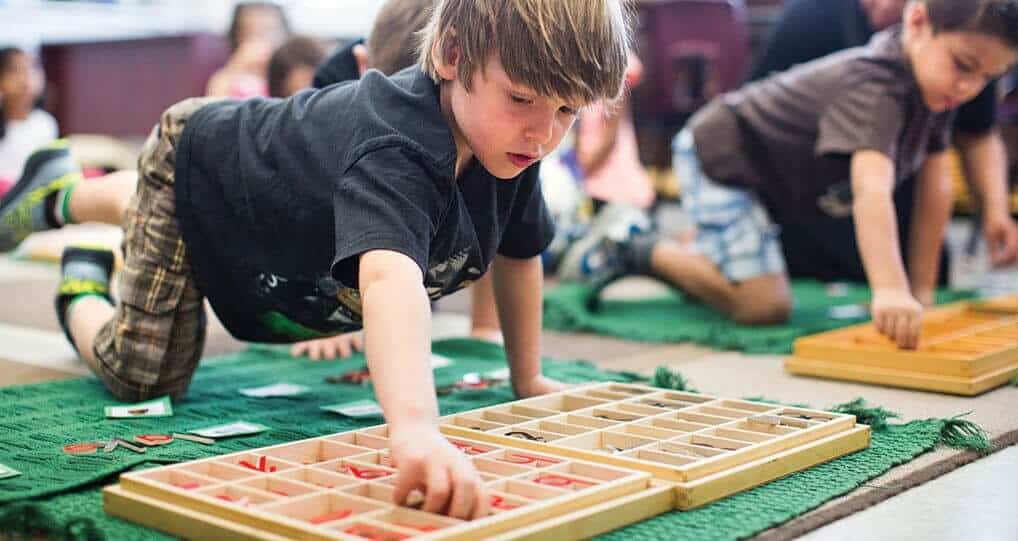
Montessori materials are designed to give children direct experiences with concepts before relying only on abstract explanations.
Children may touch, compare, sort, sequence, count, build, trace or arrange materials while exploring language, mathematics and Sensorial concepts.
This approach can help a child understand not only that an answer is correct, but how a concept works.
For example, mathematics may begin with concrete quantities that children can physically manipulate before progressing toward written symbols and more abstract operations.
3. Children Can Progress According to Readiness
Young children do not all develop at exactly the same pace.
In a Montessori classroom, teachers observe children and introduce lessons based on readiness rather than expecting every child to complete the same work at exactly the same moment.
This allows children to spend more time strengthening a skill when needed while moving forward when they are ready for additional challenge.
The result is not an unstructured classroom. Children work within a carefully prepared environment with sequenced materials, teacher guidance and clear expectations.
4. Montessori Builds Concentration Through Purposeful Work
Concentration is an important part of learning.
Montessori classrooms provide opportunities for children to choose meaningful work, focus on it and repeat it when appropriate.
A child may return to the same activity several times while refining coordination or understanding.
Over time, these repeated experiences can support a growing ability to sustain attention and complete increasingly complex sequences of work.
5. Practical Life Builds More Than Self-Care
Practical Life activities are a distinctive part of Montessori education.
They may include:
- pouring
- transferring
- buttoning and dressing skills
- food preparation
- sweeping
- washing
- care of plants
- care of classroom materials
These activities can support:
- coordination
- sequencing
- attention
- independence
- responsibility
- confidence
They also give children the experience of contributing meaningfully to the classroom community.
6. Montessori Supports Early Language Development
Language development happens throughout the Montessori environment.
Children hear precise vocabulary, participate in conversations, listen to stories and songs, and work with materials designed to support increasingly complex language skills.
As children progress, the classroom can support:
- vocabulary
- sound awareness
- letter-sound relationships
- writing preparation
- word building
- reading
- spoken communication
These skills provide a foundation children can continue building on as academic expectations increase.
7. Mathematics Develops From Concrete Experience
Montessori mathematics begins with materials that allow children to experience quantity and numerical relationships physically.
Instead of relying only on memorization, children can see and manipulate quantities before progressing toward symbols and abstract thinking.
The curriculum can gradually introduce concepts such as:
- counting
- quantity
- numeral recognition
- place value
- number relationships
- early operations
The level of work depends on each child’s developmental readiness.
8. Problem-Solving Is Part of Everyday Learning
Montessori education encourages children to observe, experiment and notice results.
Many materials allow children to recognize when something does not fit, match or follow the intended sequence.
Rather than having an adult immediately correct every mistake, children may have an opportunity to reconsider the problem and try again.
This process can help develop persistence and flexible thinking.
9. Montessori Supports Executive-Function Skills
Children use executive-function skills when they plan, remember steps, manage attention, switch between tasks and regulate behavior.
Montessori classroom routines can provide practice in these areas.
For example, a child may need to:
- choose an activity
- carry it to a workspace
- remember the demonstrated sequence
- complete the task
- return the materials
- prepare the space for the next person
These experiences combine concentration, working memory, organization and self-regulation in meaningful activities.
10. Social Development Happens Within a Classroom Community
Montessori education includes substantial independent work, but that does not mean children learn in isolation.
Children share a classroom and must learn how to participate respectfully within it.
They gradually practice:
- waiting for materials
- respecting another child’s workspace
- communicating needs
- taking turns
- solving small conflicts
- participating in group experiences
- caring for shared spaces
These everyday interactions give children opportunities to strengthen social awareness and communication.
11. Multi-Age Classrooms Offer a Different Learning Dynamic
Montessori Primary classrooms commonly include children across a developmental age range.
That means a younger preschool child and an older child preparing for kindergarten may share the same classroom community while working at very different levels.
Younger children can observe more experienced classmates using materials and managing routines.
Older children may gain opportunities to model responsibility and leadership.
The teacher continues to introduce lessons according to each child’s individual readiness.
12. Montessori Can Support Preschool and Pre-K Readiness
The preschool years are a period of rapid development in language, coordination, concentration, social interaction and reasoning.
Montessori Primary integrates these areas rather than separating “academic” learning from everyday developmental skills.
A child may work on pouring in Practical Life, phonetic sounds in Language and number relationships in Mathematics during the same broader classroom experience.
Families comparing early-childhood programs can explore MSSL’s Preschool & Pre-K in Sugar Land and Missouri City guide.
13. Kindergarten Can Build on Earlier Montessori Experiences
For children who remain in Montessori Primary through kindergarten, the kindergarten year can become the culminating stage of a multi-year developmental cycle.
Instead of entering an entirely unfamiliar curriculum, children can continue building on materials, routines and concepts they already know.
Their work can become increasingly advanced in:
- reading
- writing
- mathematics
- science
- geography
- cultural studies
They may also assume greater responsibility within the classroom community.
Families approaching this stage can explore MSSL’s Private Kindergarten in Sugar Land and Missouri City guide.
Does Montessori Guarantee Future Academic Success?
No educational approach can guarantee how a child will perform later in school.
Children develop differently, and future outcomes depend on many factors including family circumstances, teachers, future schools, individual needs and experiences outside the classroom.
A more useful way to think about Montessori is that it gives children regular opportunities to practice abilities that are valuable for continued learning, including:
- independence
- concentration
- communication
- organization
- problem-solving
- persistence
- academic foundations
Those abilities can help children approach new learning environments with a growing sense of capability.
Does Montessori Prepare Children for Traditional Elementary School?
Children leaving Montessori may encounter a different classroom structure in elementary school.
The transition will vary from child to child and from school to school.
However, children who have practiced following routines, completing independent work, communicating with adults and peers, and caring for materials already have experience with many behaviors that are useful in a wide range of classrooms.
What Parents Should Look for in a Montessori Preschool
The Montessori name alone does not tell parents everything they need to know.
A school tour is an opportunity to observe how Montessori principles actually appear in the classroom.
Look for:
- organized, accessible materials
- child-sized furniture and tools
- calm, respectful teacher-child interactions
- meaningful opportunities for independence
- hands-on learning
- uninterrupted periods of purposeful activity
- clear classroom expectations
- materials appropriate for the child’s developmental stage
- teachers who can explain how lessons progress
Questions to Ask During a Preschool Tour
- How do teachers decide when a child is ready for a new lesson?
- How long is the uninterrupted work period?
- How is independence encouraged?
- How are language and mathematics introduced?
- How are conflicts between children handled?
- How is progress communicated to families?
- How does the Primary curriculum progress toward kindergarten?
- How much outdoor time is included?
- What does a typical day look like?
Frequently Asked Questions About Montessori and School Readiness
Does Montessori teach reading and math?
Yes. Montessori Primary includes language and mathematics along with Practical Life, Sensorial and cultural studies. Children progress through increasingly complex work according to readiness.
Is Montessori only about independent learning?
No. Children work independently at times, but they also interact with teachers and classmates and participate in a classroom community.
Does Montessori use worksheets?
Montessori early-childhood learning generally emphasizes hands-on materials and direct experience, particularly when introducing new concepts.
Can Montessori help children become more independent?
The environment intentionally provides age-appropriate opportunities for children to complete tasks, care for materials and participate in everyday classroom routines with increasing independence.
How does Montessori prepare children for kindergarten?
Montessori Primary can support language, mathematics, concentration, independence, communication and classroom routines while progressively introducing more advanced work.
Can Montessori children transition to other schools?
Children move between different educational environments for many reasons. How easily a particular child adjusts depends on the child and the receiving school, but independence, communication and classroom-management skills can be useful during transitions.
Montessori Education in Sugar Land and Missouri City
Montessori School of Sugar Land serves families through two Fort Bend County campuses.
Sugar Land Campus
4502 Austin Parkway
Sugar Land, TX 77479
Sienna Campus
8900 Sienna Ranch Road
Missouri City, TX 77459
Families can explore programs ranging from early-childhood care through Montessori Primary and private kindergarten.
Continue Exploring MSSL
1. Montessori School — start here
Montessori School in Sugar Land & Missouri City →
2. Preschool & Pre-K
Preschool & Pre-K in Sugar Land & Missouri City →
3. Private Kindergarten
Private Kindergarten in Sugar Land & Missouri City →
4. Explore All Programs
View MSSL Montessori Programs →
Building Skills for the Next Stage
The benefits of Montessori education extend beyond early exposure to reading or mathematics.
A carefully prepared Montessori environment gives young children repeated opportunities to concentrate, make choices, solve problems, communicate, work with their hands and become increasingly independent.
Those experiences create a foundation children can continue building on as school becomes more complex.
For parents comparing preschool or Montessori options in Sugar Land and Missouri City, the best way to understand the approach is to see the environment in action.
Visit MSSL
Tour MSSL’s Sugar Land or Sienna campus to see how Montessori supports independence, hands-on learning and school readiness during the early-childhood years.