When parents compare preschool vs. Pre-K, the biggest differences usually involve age, developmental goals, independence, and kindergarten preparation. Preschool typically introduces younger children to classroom routines, social interaction, and early independence, while Pre-K builds on those skills as children prepare for kindergarten.
However, the difference between preschool and Pre-K is not always as simple as an age range. Program names, classroom expectations, teaching methods, and enrollment requirements can vary from one school to another.
For families searching for preschool or Pre-K in Sugar Land, Missouri City, Sienna, and nearby Fort Bend County communities, understanding these differences can make it easier to choose an environment that supports the whole child.
What Is the Difference Between Preschool and Pre-K?
The main difference between preschool and Pre-K is the developmental stage each program is designed to support.
Preschool generally serves younger children who are beginning to develop classroom independence, communication, social skills, concentration, and comfort with a daily routine.
Pre-K, short for pre-kindergarten, generally serves children who are closer to kindergarten age. Pre-K builds on early childhood skills while placing additional emphasis on kindergarten readiness, problem-solving, early literacy, early math, and independent participation.
Quick answer: Preschool introduces children to the classroom experience. Pre-K builds on that foundation and helps children prepare for kindergarten. Exact ages, expectations, and program names vary by school.
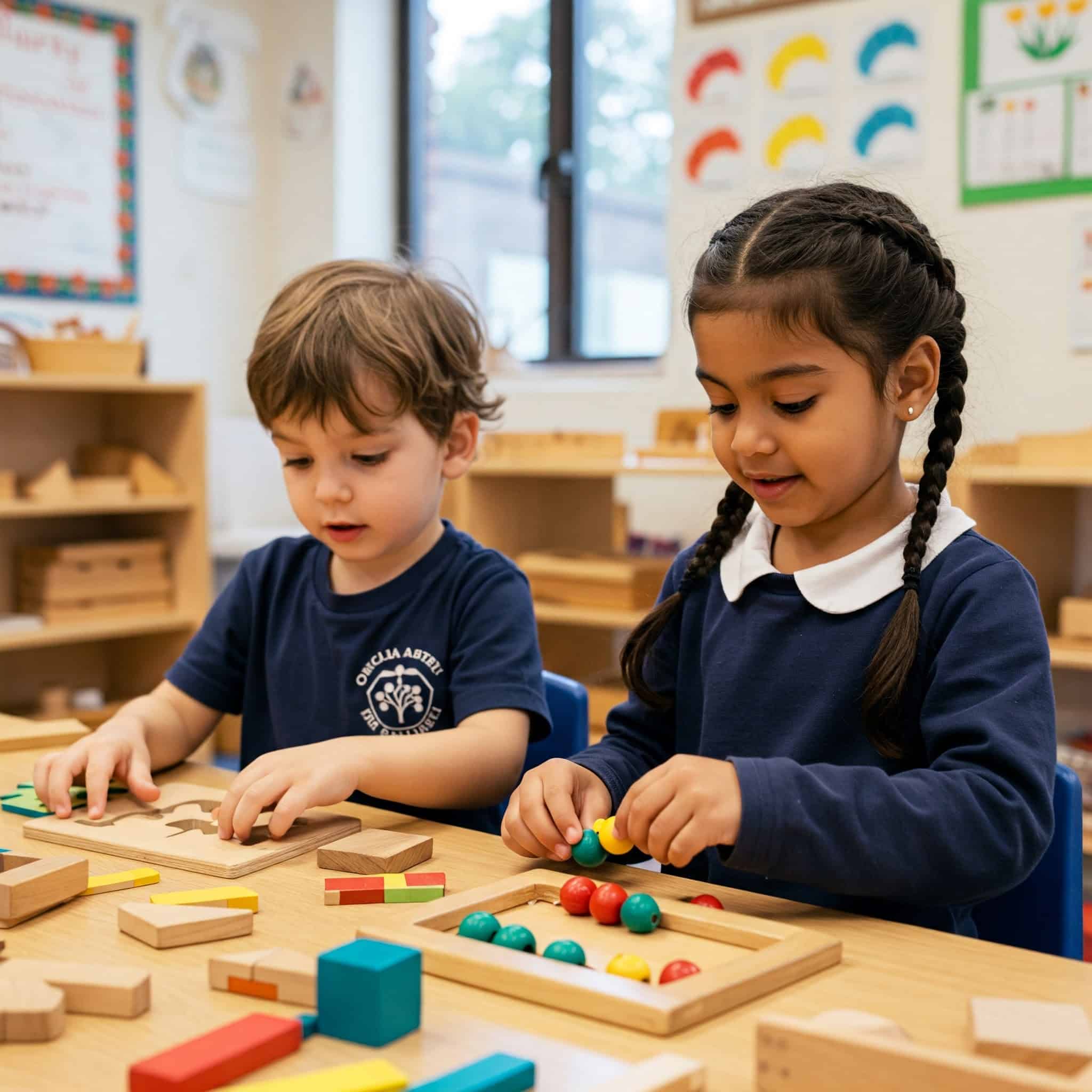
In a Montessori environment, preschool-age and Pre-K-age children may learn together in a mixed-age Primary classroom. Children receive lessons according to individual readiness rather than moving through a one-size-fits-all curriculum based only on age.
What Is Preschool?
Preschool is an early childhood education program that usually serves children before they reach kindergarten age. Many preschool programs include children between approximately 2½ and 4 years old, although enrollment ages vary.
For many children, preschool is their first regular experience in a classroom community outside the home. The preschool environment gives children opportunities to interact with teachers, work near other children, follow a predictable routine, and develop practical independence.
What Do Children Learn in Preschool?
A high-quality preschool program supports development across many areas, including:
- Language and communication.
- Social-emotional development.
- Fine and gross motor coordination.
- Early literacy and number awareness.
- Practical life and self-care skills.
- Concentration and attention.
- Problem-solving.
- Creativity and imagination.
- Confidence in a classroom setting.
Preschool is not simply about memorizing letters, numbers, shapes, and colors. Those concepts are valuable, but young children also need opportunities to move, speak, listen, explore, create, repeat, and complete meaningful tasks.
Common Preschool Activities
Depending on the school and educational approach, preschool children may participate in:
- Storytelling and language activities.
- Sorting, matching, counting, and pattern work.
- Art, music, and movement.
- Outdoor play and nature exploration.
- Practical tasks such as pouring, cleaning, and food preparation.
- Building, puzzles, and hands-on problem-solving.
- Grace and courtesy lessons.
- Individual and small-group learning activities.
The strongest preschool environments recognize that young children learn through active participation rather than long periods of passive instruction.
What Is Pre-K?
Pre-K is an early education program generally intended for children during the year or two before kindergarten. Many Pre-K programs serve children around ages 4 to 5, although age requirements and kindergarten cutoff dates vary.
Pre-K continues supporting social, emotional, physical, and cognitive growth while giving children opportunities to practice skills that will help them transition successfully into kindergarten.
What Do Children Learn in Pre-K?
A developmentally appropriate Pre-K program may support:
- Early reading and writing foundations.
- Phonological and sound awareness.
- Letter formation and pencil control.
- Counting and number relationships.
- Patterns, sequencing, and early operations.
- Longer periods of concentration.
- Independent classroom routines.
- Group communication and collaboration.
- Emotional regulation and conflict resolution.
- Confidence before entering kindergarten.
Pre-K may include more advanced academic experiences than preschool, but it should still respect how young children learn. Children continue to need movement, hands-on materials, creative work, outdoor experiences, conversation, and meaningful choices.
A strong Pre-K program prepares children for kindergarten without removing the curiosity, movement, creativity, and joy that make early childhood learning meaningful.
Preschool vs. Pre-K Comparison Chart
| Area | Preschool | Pre-K |
|---|---|---|
| Typical age range | Approximately 2½ to 4 years | Approximately 4 to 5 years |
| Main purpose | Introduce classroom routines and foundational development | Build on early skills and prepare for kindergarten |
| Independence | Beginning self-care and classroom responsibility | Greater independence with routines, materials, and work |
| Social development | Learning to share space, communicate, and take turns | Collaboration, leadership, problem-solving, and group participation |
| Language | Vocabulary, conversation, listening, and storytelling | Sound awareness, comprehension, writing readiness, and detailed expression |
| Math | Sorting, matching, counting, quantity, and patterns | Number relationships, sequencing, operations, and problem-solving |
| Attention | Shorter activities with movement and repetition | Longer periods of purposeful concentration |
| Practical skills | Beginning dressing, cleanup, pouring, and personal care | More complex self-care, organization, and classroom responsibility |
| Teacher support | More guidance while children learn classroom routines | Increasing independence with targeted guidance |
| Kindergarten readiness | Builds the early foundation | Supports the transition into kindergarten |
These differences are general guidelines, not universal rules. Schools may use the terms preschool, Pre-K, prekindergarten, early childhood, or Primary differently.
How Are Preschool and Pre-K Similar?
Preschool and Pre-K share many important goals. Both should help children become confident, curious, capable members of a classroom community.
Both Support Social-Emotional Growth
Children in preschool and Pre-K learn how to communicate, wait, cooperate, express feelings, respect others, and solve small problems.
These abilities are essential for future school success. A child who can ask for help, recover from disappointment, and participate respectfully is developing valuable readiness skills.
Both Introduce Early Academic Concepts
Both programs may include language, literacy, mathematics, science, geography, art, music, movement, and cultural studies.
The difference is often found in the complexity of the work and the child’s level of independence rather than in completely different subject areas.
Both Should Include Hands-On Learning
Young children learn by doing. They need opportunities to touch, move, sort, count, compare, build, pour, observe, speak, draw, and repeat.
Hands-on learning helps children connect abstract ideas to real experiences and encourages deeper understanding.
Both Help Children Build Confidence
Confidence develops when children are trusted with meaningful work, given appropriate challenges, and allowed enough time to practice.
Whether a child is in preschool or Pre-K, the environment should communicate: “You are capable, your work matters, and you can continue trying.”
Is Pre-K More Academic Than Preschool?
Pre-K often includes more advanced academic foundations because children are closer to kindergarten. However, more academic should not mean more pressure, more worksheets, or less movement.
Developmentally appropriate Pre-K may introduce:
- Rhyming and sound awareness.
- Letter-sound relationships.
- Early handwriting and letter formation.
- Counting larger quantities.
- Comparing numbers and quantities.
- Simple addition and subtraction concepts.
- Scientific observation and classification.
- More detailed storytelling and conversation.
- Multi-step practical tasks.
These skills are most meaningful when introduced through purposeful experiences and developmentally appropriate materials.
Preschool or Pre-K: Which Program Is Right for Your Child?
Choosing between preschool and Pre-K is not about selecting the program with the more advanced-sounding name. The best placement is the one that offers the right combination of support, challenge, independence, and emotional security.
Preschool May Be a Good Fit When Your Child Is:
- Approximately 2½ to 4 years old.
- New to a regular classroom environment.
- Beginning to separate from parents or caregivers.
- Learning to communicate basic needs.
- Developing self-care skills.
- Practicing how to follow classroom routines.
- Beginning to interact with other children.
- Exploring materials for shorter periods.
Pre-K May Be a Good Fit When Your Child Is:
- Approaching kindergarten age.
- Comfortable with a classroom routine.
- Communicating ideas in greater detail.
- Working independently for longer periods.
- Interested in letters, sounds, words, numbers, or patterns.
- Participating in group activities.
- Managing belongings with less adult assistance.
- Ready for increased kindergarten preparation.
Children do not need to demonstrate every skill on either list. These are developmental observations rather than admission tests.
Consider the Whole Child
Age is important, but readiness also includes:
- Communication.
- Emotional development.
- Independence.
- Social comfort.
- Curiosity.
- Motor coordination.
- Previous school experience.
- Ability to participate in routines.
Two children with the same birthday may have very different strengths and needs. A thoughtful school considers the complete developmental picture.
How Montessori Approaches Preschool and Pre-K
Montessori education does not always separate preschool and Pre-K into completely different classrooms.
In a Montessori Primary environment, children approximately ages 2½ through 6 commonly learn together in a carefully prepared mixed-age classroom. Younger and older children use the same environment while working with materials that match their individual developmental readiness.
Lessons Are Based on Individual Readiness
Montessori teachers observe each child and introduce lessons based on readiness, interest, and previous understanding.
A child may be working at an advanced level in language while continuing to develop confidence in practical life or social communication. Another child may have strong mathematical understanding while moving more gradually through early writing.
This individualized approach helps children progress without unnecessary pressure or artificial limits.
Younger Children Learn Through Observation
Younger children naturally observe older classmates completing advanced work, caring for the environment, and following classroom routines.
These observations provide motivation and help younger children understand what they may eventually be able to accomplish.
Older Children Develop Leadership
Older children reinforce their own knowledge when they model routines, demonstrate kindness, and assist younger classmates appropriately.
Leadership experiences support confidence, patience, empathy, and communication.
The Montessori Environment Supports Independence
A Montessori classroom is intentionally organized so children can participate actively.
- Materials are displayed on accessible shelves.
- Furniture and practical tools are sized for children.
- Activities are arranged in a logical sequence.
- Children choose from purposeful learning options.
- Children complete a work cycle and return materials.
- Teachers guide children without completing every task for them.
These routines help children develop concentration, organization, coordination, responsibility, and confidence.
Montessori Curriculum Areas
Montessori preschool and Pre-K-age children may work in several interconnected curriculum areas:
- Practical Life: self-care, care of the environment, coordination, and independence.
- Sensorial: classification, comparison, pattern recognition, and refinement of the senses.
- Language: vocabulary, sound awareness, writing, reading, and communication.
- Mathematics: quantity, symbols, place value, operations, and problem-solving.
- Cultural Studies: science, geography, nature, art, music, and the wider world.
- Grace and Courtesy: respectful communication, social awareness, and community responsibility.
Families can learn more about the Montessori programs at MSSL and explore why families choose Montessori School of Sugar Land.
What Kindergarten Readiness Really Means
Kindergarten readiness includes much more than reading, writing, and counting. Children also benefit from practical, emotional, physical, and social skills.
Kindergarten Readiness Checklist
A child preparing for kindergarten may be developing the ability to:
- Communicate needs and ask for help.
- Follow familiar one-step and two-step directions.
- Participate in a predictable daily routine.
- Separate from a parent or caregiver.
- Use the bathroom with age-appropriate independence.
- Wash and dry hands.
- Carry and organize personal belongings.
- Listen during a story or group conversation.
- Work independently for an appropriate period.
- Take turns and respect shared materials.
- Express emotions with words.
- Recover from small frustrations.
- Show interest in letters, sounds, stories, numbers, and patterns.
- Use crayons, pencils, scissors, and classroom tools.
- Approach new activities with curiosity.
A child does not need to master every skill before entering kindergarten. Readiness develops over time through repeated opportunities, patient guidance, and a supportive classroom environment.
Choosing Preschool or Pre-K in Sugar Land and Fort Bend County
Families searching for a preschool or Pre-K program in Sugar Land, Missouri City, Sienna, First Colony, Riverstone, Telfair, New Territory, Stafford, Fresno, Rosharon, Arcola, and surrounding Fort Bend County communities should look beyond the classroom label.
Consider the quality of the environment, the teaching philosophy, teacher-child interactions, classroom organization, outdoor opportunities, family communication, and how the school supports each child’s development.
Preschool and Pre-K at Montessori School of Sugar Land
At Montessori School of Sugar Land, preschool-age and Pre-K-age children learn in carefully prepared Montessori Primary environments designed to support children approximately ages 2½ through 6.
Rather than expecting every child to complete the same lesson at the same time, MSSL teachers observe individual development and introduce hands-on learning experiences according to readiness.
MSSL families benefit from:
- Two Fort Bend County campus locations.
- A Sugar Land campus in the First Colony area.
- A Sienna campus serving Missouri City and surrounding communities.
- Montessori programs for children from infancy through age 12.
- Year-round enrollment.
- Monday–Friday hours from 7:00 AM to 6:00 PM.
- Carefully prepared Montessori classrooms.
- Individualized, hands-on learning.
- Practical Life, Sensorial, Language, Mathematics, and Cultural Studies.
- Outdoor play and learning experiences.
- Enrichment opportunities.
- A warm, caring school community.
Learn more about our Sugar Land Montessori Campus or explore the Sienna Montessori Campus.
Communities Served by the Sugar Land Campus
Our Sugar Land campus is convenient for families in Sugar Land, First Colony, Telfair, New Territory, Stafford, Riverstone, Missouri City, and nearby areas.
Communities Served by the Sienna Campus
Our Sienna campus serves families from Sienna, Missouri City, Rosharon, Fresno, Arcola, Riverstone, and surrounding Fort Bend communities.
Questions to Ask During a Preschool or Pre-K Tour
A school tour allows parents to see whether the actual classroom experience matches the school’s description.
Consider asking:
- What ages are included in the classroom?
- How are children placed in preschool or Pre-K?
- What does a typical day look like?
- How does the program support independence?
- How are language and early literacy introduced?
- How are mathematics and problem-solving taught?
- How much uninterrupted learning time do children receive?
- How often do children spend time outdoors?
- How do teachers support separation anxiety?
- How are social conflicts handled?
- How does the school prepare children for kindergarten?
- How is progress communicated to families?
- What enrichment activities are available?
- What are the school’s operating hours?
- Is enrollment available throughout the year?
What to Observe During the Tour
Look beyond the furniture and decorations. Observe how the classroom functions.
- Do children appear engaged in meaningful activity?
- Are teachers calm, respectful, and attentive?
- Can children access materials independently?
- Does the classroom feel organized and welcoming?
- Are children given time to concentrate?
- Are mistakes treated as opportunities to learn?
- Do children move with purpose and confidence?
- Does the environment support different developmental levels?
The strongest early childhood environment is one where children feel safe, respected, capable, and interested in their work.
Common Misconceptions About Preschool vs. Pre-K
Pre-K Is Always Better Than Preschool
Pre-K is not automatically better. It is intended for a later developmental stage. A younger child may thrive in a preschool environment that provides the right support, routines, movement, and opportunities for independence.
Preschool Is Just Childcare
A high-quality preschool program supports language, movement, social development, concentration, independence, creativity, practical skills, and early academic understanding.
Pre-K Should Look Like Kindergarten
Pre-K should prepare children for kindergarten without copying an elementary classroom. Young children still need hands-on work, movement, choice, outdoor exploration, creativity, and age-appropriate expectations.
Children Must Read Before Kindergarten
Some children begin reading before kindergarten, while others are still strengthening vocabulary, sound awareness, letter recognition, and comprehension.
Strong early literacy preparation builds a complete foundation instead of rushing every child toward the same milestone.
Academic Readiness Is the Only Thing That Matters
School readiness also includes confidence, communication, emotional regulation, coordination, independence, listening, curiosity, and the ability to participate in a classroom community.
Frequently Asked Questions About Preschool vs. Pre-K
Is preschool the same as Pre-K?
No. The terms may sometimes be used interchangeably, but preschool generally serves younger children, while Pre-K is usually designed for children closer to kindergarten age.
What age is preschool?
Preschool commonly includes children between approximately 2½ and 4 years old. Exact enrollment ages vary by school and program.
What age is Pre-K?
Pre-K commonly serves children around ages 4 to 5, often during the year before kindergarten. School policies and local cutoff dates may affect eligibility.
Can a 3-year-old attend Pre-K?
Most Pre-K programs are designed for older children, but terminology varies. Some schools combine age groups or use different names for their early childhood classrooms.
Should my child attend preschool before Pre-K?
Many children benefit from preschool before Pre-K because it provides additional time to develop independence, classroom comfort, social skills, communication, and familiarity with routines.
Can a child skip preschool and begin with Pre-K?
Yes. Some children begin their classroom education in Pre-K. They may initially need additional support with separation, social expectations, and classroom routines.
Is Pre-K required before kindergarten?
Requirements vary by state, district, and program. Even when Pre-K is not required, a high-quality early childhood environment can provide valuable practical, academic, social, and emotional preparation.
Is Montessori preschool also Pre-K?
A Montessori Primary classroom may include both preschool-age and Pre-K-age children in one mixed-age environment. Lessons are presented according to each child’s readiness rather than assigned only by age.
Is Pre-K harder than preschool?
Pre-K may include more complex work and greater expectations for independence, but it should remain developmentally appropriate. The goal is continued growth, not unnecessary pressure.
Which is better, preschool or Pre-K?
Neither program is universally better. The right choice depends on the child’s age, development, previous experience, and the quality of the learning environment.
What should a child know before Pre-K?
A child does not need to read, write, or complete advanced math before Pre-K. Growing communication, independence, curiosity, attention, emotional regulation, and willingness to participate are valuable foundations.
Does Pre-K guarantee kindergarten success?
No single program can guarantee future outcomes. However, a supportive Pre-K environment can help children develop confidence, classroom experience, language, early academics, and social-emotional skills that contribute to a smoother transition.
What if my child is shy?
Some children observe quietly before participating. A predictable environment, patient teachers, consistent routines, and gradual relationship-building can help shy children feel more comfortable.
Does my child need to be potty trained?
Bathroom expectations vary by school and classroom. Parents should ask each program about its specific policy and how teachers support children who are still developing toileting independence.
How do I know which program my child needs?
Consider your child’s age, communication, independence, social-emotional development, curiosity, concentration, and previous classroom experience. A school visit and conversation with an experienced educator can help clarify appropriate placement.
Final Thoughts: Choose the Environment, Not Just the Label
When comparing preschool vs. Pre-K, remember that the name of the program is only one part of the decision.
Preschool often introduces children to the classroom experience, while Pre-K builds on that foundation and supports the transition toward kindergarten. Both should respect the child’s developmental stage and preserve the curiosity, movement, creativity, and hands-on learning that make early childhood meaningful.
The best program is not necessarily the one that appears most advanced. It is the one that supports your child’s current needs while helping them become more independent, confident, capable, and enthusiastic about learning.
Not Sure Whether Your Child Needs Preschool or Pre-K?
Visit Montessori School of Sugar Land and speak with our team about your child’s age, development, previous classroom experience, and readiness. During a campus tour, you can explore our carefully prepared Montessori environments and learn how the Primary program supports children approximately ages 2½ through 6.